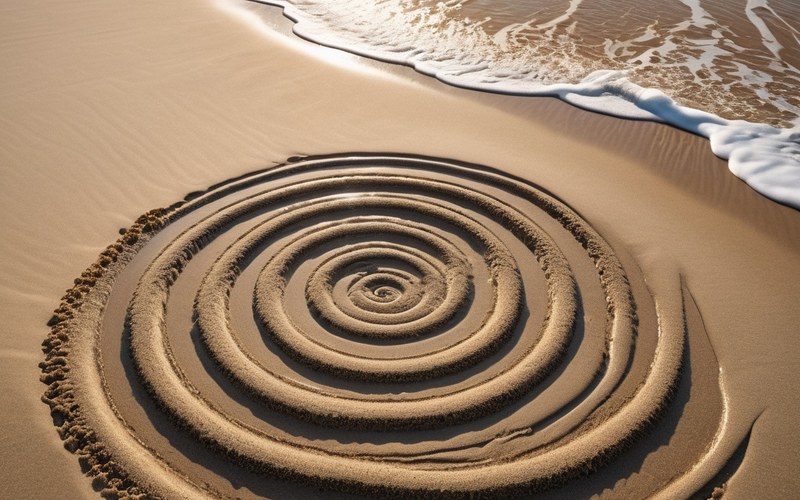
Spiral Vortex Pool
Dig a spiral, fill it with water, and watch it swirl
A shallow spiral trench, dug inward from a wide outer ring to a small deep pool at the centre. When water is poured in at the outer end, it spirals down the channel and collects in the middle, creating a satisfying swirling effect that younger children in particular find mesmerising. It's part sculpture, part working water feature, and needs almost no engineering knowledge to get right — just patience with the shaping.
Quick Facts
| Best for ages | 4 and up |
|---|---|
| Time to build | 45–75 minutes |
| Tools needed | spade, bucket, trowel |
| Water needed? | Yes |
When to Dig It
Best Conditions
Advertisement
How to Dig It
- Mark out a spiral shape in the sand with a stick, starting wide on the outside and winding inward to a small central point — three or four full turns works well.
- Dig along the marked line to create a shallow trench, roughly 8–10cm deep and 10cm wide, following the spiral all the way to the centre.
- At the very centre, dig a slightly deeper pool, around 15–20cm deep, to collect the water.
- Smooth and firm the trench walls with your hands or the back of a trowel so the water flows rather than seeping straight into the sand.
- Starting from the outer end, pour water slowly and steadily and watch it spiral its way down to the centre pool.
- Refill and repeat — the trench often flows better on the second or third pour once the sand has dampened.
Variations
Add small dams or 'gates' at intervals along the spiral using flat stones to slow the water and see how it backs up. For older children, try digging two interleaved spirals that never quite touch, racing water down each one.
Seasonal Tips
Spring
Cool, damp sand is ideal — the spiral holds its shape well and water flows cleanly.
Summer
Dig just above the waterline where sand is naturally a little damp; bone-dry sand needs several practice pours before it holds water.
Autumn
Reliable digging conditions with good moisture — one of the best seasons for this project.
Winter
Works well in cold wet sand, though hands get cold fast — bring gloves for the shaping stage.
Try This Hole on Every Beach Type
Flat Sandy Beach
Spiral Vortex Pool on a flat sandy beach →
Steep Shingle Beach
Spiral Vortex Pool on a steep shingle beach →
Tidal Flat Beach
Spiral Vortex Pool on a tidal flat beach →
Rock Pool Beach
Spiral Vortex Pool on a rock pool beach →
Shell Beach
Spiral Vortex Pool on a shell beach →
Tropical Coral Sand Beach
Spiral Vortex Pool on a tropical coral sand beach →
Estuary Beach
Spiral Vortex Pool on a estuary beach →
Sheltered Cove
Spiral Vortex Pool on a sheltered cove →